


[Event Report] The 60th Special Breakfast Meeting “Redesigning Social Security for Sustainability for a Society With Rapid Population Decline” (November 28, 2025)
date : 1/28/2026

![[Event Report] The 60th Special Breakfast Meeting “Redesigning Social Security for Sustainability for a Society With Rapid Population Decline” (November 28, 2025)](https://hgpi.org/en/wp-content/uploads/sites/2/0L6A8691_web.jpg)
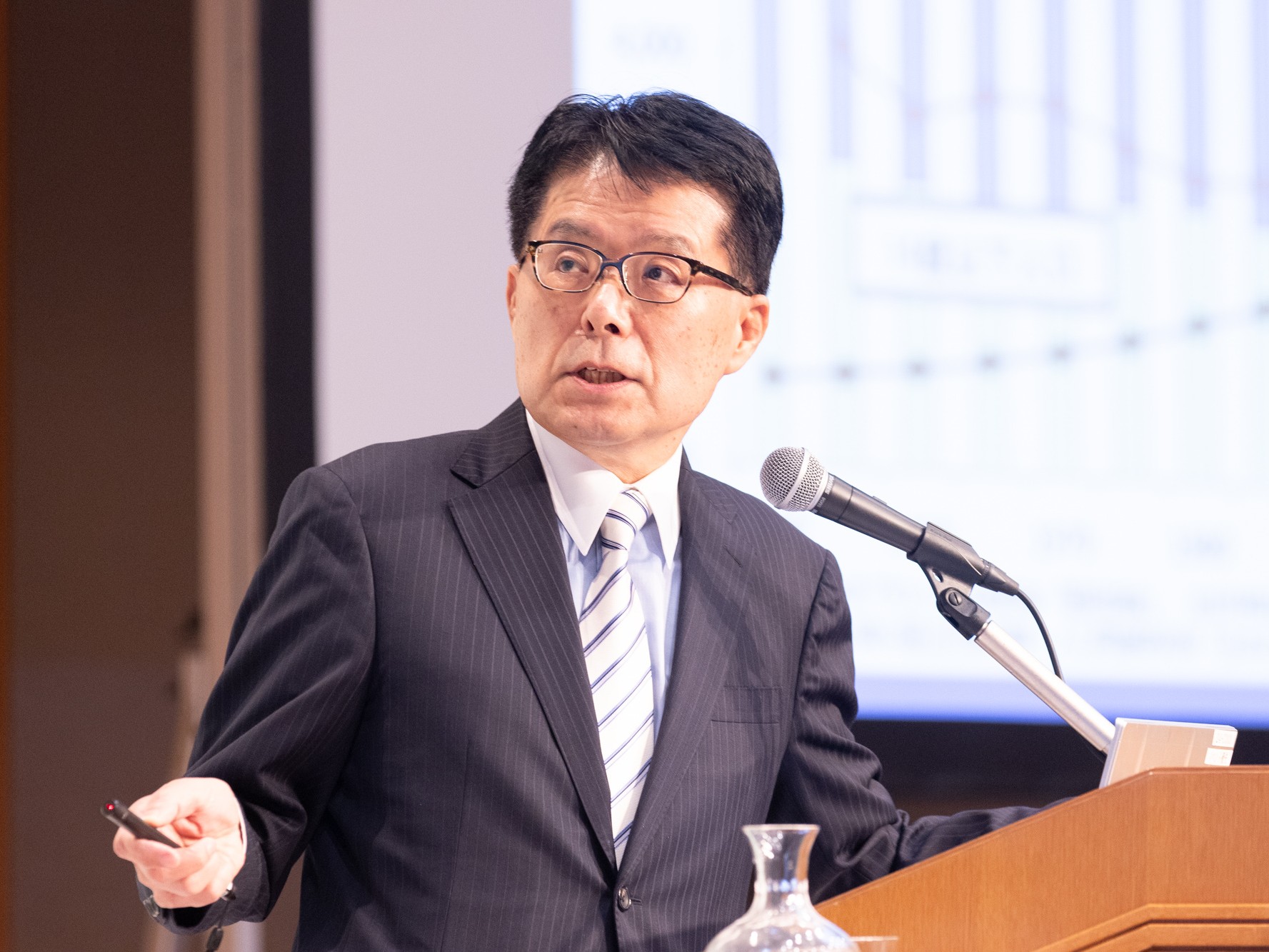
For the 60th Special Breakfast Meeting, Health and Global Policy Institute (HGPI) was honored to host Mr. Hiroya Masuda, who serves as Co-Representative of Reinventing Infrastructure of Wisdom and Action (ReIWA) and Advisor to Nomura Research Institute, Ltd.
Mr. Masuda has been actively offering various proposals for Japan’s future, and at this meeting, he spoke on redesigning Japan’s social security system for sustainability as the population rapidly declines.
<Key points of the lecture>
- As Japan’s population is projected to continue to decline and age as the year 2040 approaches, we must accelerate efforts to realize Regional Medical Care Visions by reorganizing and coordinating healthcare provision systems in a manner that suits real-world circumstances in each region. In particular, there are widening gaps in demand for healthcare and long-term care among depopulated and urban areas that must be addressed.
- As Japan’s demographic profile changes, the cost of social security benefits is projected to reach approx. 190 trillion yen in 2040. This represents an increase of approx. 50 trillion yen. It is vital that Japan introduce systems designed to distribute this increased burden equitably by taking into account individual capacity to pay. Measures may include mitigating the increase in burden for members of the working-age generation and raising out-of-pocket payment rates for senior citizens whose assets match those of working households (e.g., to 30%).
- Making effective use of limited financial, healthcare, and long-term care resources will require comprehensive social security system reform that creates a “social security system oriented to all generations” and that emphasizes fairness, sustainability, and efficiency in burdens and benefits for both the working-age and senior generations. Such reforms aim to maintain income and living standards for the working-age generation by controlling the cost of healthcare and long-term care (such as through the effective use of Regional Medical Coordination Promotion Corporations or by allowing for prescription refills).
■Changes in Japan’s demographic profile by 2040
As evidenced by the shape of Japan’s population pyramid, there is clear change occurring in the national demographic profile. In 1965, that pyramid was an equilateral triangle, with many young people and few senior citizens. Since then, it has taken on a pot shape, which is expected to become more pronounced as the population that is 75 years of age and older grows significantly by 2050. It will become even more top-heavy as the birthrate continues to decline, making it difficult to maintain the conventional burden structure that has been centered on the working-age generation. Having a broad range of people (including senior citizens with assets) pay according to their individual capacity will be of increasing importance.
The year 2040 marks a pivotal point for the future outlook of the social security system. It is the year that the working-age population is projected to decline, when all baby boomers will reach age 75 years and older (referred to as, “advanced elderly”), and when the number of senior citizens living alone will also increase. The number of elderly single-person households with limited assets is projected to increase around 2035, when members of the Employment Ice Age generation begin to account for the majority of single senior-citizen households. The decline in births is another serious issue, with births in Japan having dropped to 686,000 in 2023. The overall fertility rate is currently about 1.15 and may further decline in the future. Unlike the temporary decline in births that occurred during the “Fire Horse” year in the 1960s, this decline is unique in that it is the result of a consistently low fertility rate.
■Current circumstances for the social security system and surrounding issues
Over the long term, domestic spending on social security benefits has increased and there have been major changes in the budget scope over the past several decades. While these expenditures accounted for only one-fourth to one-fifth of public expenditures before the 1990s, they have now grown to a total of approx. 140 trillion yen. This has been mainly due to increased spending on pensions and includes items such as healthcare and long-term care. As of 2025, payments made for social security benefits accounted for 22.4% of the gross domestic product (GDP).
In the future, payments for social security benefits are projected to reach approx. 190 trillion yen in 2040, with the proportion of GDP increasing slightly from current levels. However, increased social security benefit expenditures may lead to greater feelings of burden in the event that long-term economic growth is limited, and it has been pointed out that periods of low growth or prolonged deflation have resulted in an increased social security cost burden in the past.
There are also noteworthy changes in the structure of social security demand. In particular, the number of senior citizens age 85 years and older is projected to increase, as are their combined needs for healthcare and long-term care. As members of this age group visit healthcare institutions more frequently and make greater use of long-term care services, healthcare and long-term care must be considered in an integrated manner.
Demand for emergency and in-home medical services is also expected to increase. It is projected that people age 85 years and older will require approx. 75% more emergency medical transports by 2040. Meanwhile, demand for in-home medical care is expected to increase by approx. 60%, mainly in rural areas. These changes mean that securing systems for supplying community healthcare and long-term care services will become an issue.
■Regional disparities in population decline and challenges for the healthcare system
Throughout Japan, many municipalities are experiencing population decline, and populations are expected to decline in almost every region except for certain urban areas, like Tokyo. According to data from the National Land Council of the Ministry of Land, Infrastructure, Transport and Tourism (MLIT), approx. 30% of municipalities will have half or less of their current populations in 2050. In particular, population decline will be pronounced in semi-mountainous areas or lightly-populated areas. Maintaining healthcare provision systems in such areas is likely to become difficult.
On the other hand, when asked about where they want to live, residents strongly wish to continue living in familiar areas where they have lived for many years. Even when it is desirable that they relocate from semi-mountainous areas to flatlands for the sake of efficient healthcare provision, in many cases, this is impractical. As such, the wishes of residents must also be taken into account when planning healthcare systems in semi-mountainous areas.
There are also major differences in healthcare provision systems among urban and depopulated areas. Urban areas will see a continued increase in combined demand for healthcare and long-term care, particularly among senior citizens age 85 years and older. Meanwhile, depopulated areas are expected to see major decreases in healthcare demand itself due to shrinking working-age populations. Some are concerned that these regional differences will give rise to an imbalance in the distribution of medical resources or in provision systems.
The number of people receiving outpatient medical services has already peaked in many medical care areas, and it is estimated that the tendency for newly-established facilities and physician placements to concentrate in urban areas will continue to strengthen. Additionally, population decline is not uniform across Japan; it varies due to the impact of social factors, as seen with the concentration of the population in Tokyo. This is why it will be necessary to build flexible healthcare systems that suit regional demographic profiles and circumstances surrounding healthcare resources in each community.
To address this need and enhance the effectiveness of Regional Medical Care Visions, it will be important to grant prefectural governors clear authority and responsibility to plan and implement healthcare provision systems that meet real-world conditions in their respective regions. It will be especially important to implement regional medical reforms with sights set on 2040 by optimizing the number of care beds and efficiently allocating medical resources.
■The burden of social insurance premiums and challenges facing reform for a “social security system oriented to all generations”
The burden placed on the working-age generation in Japan’s social security system is a key issue. Health insurance premium rates at the Japan Health Insurance Association approached around 30% of remuneration in 2025, with individuals shouldering about half (approx. 15%). Overall, the main components of social insurance premiums are pensions, healthcare, and long-term care. In 2017, a macroeconomic slide for pensions was introduced, fixing premiums at 18.3% and avoiding a sharp increase in that particular burden. However, the long-term care sector still faces the lingering issue of improving compensation for personnel, and wage standards must be improved.
Reforming social security will require both controlling healthcare and long-term care expenses as well as securing disposable income for the working-age generation. Options for streamlining healthcare expenses include utilizing Regional Medical Coordination Promotion Corporations and introducing integrated payment and prescription refill services for outpatient care. Furthermore, since it is necessary to connect medical service fees and labor costs to increases in the cost of living or improvements in compensation for personnel, it will be important to implement transparent data management practices to ensure that wage increases are not concentrated among certain occupations or individuals.
The “social security system oriented to all generations” refers to the comprehensive reform of healthcare and long-term care provision systems ahead of 2040. Its foundation is the comprehensive reform of tax and social security systems and it emphasizes a fair, sustainable, and efficient distribution of burdens and benefits between the working-age and senior generations. Achieving these goals will require introducing measures that aim to curb premium rate hikes for the working-age generation and ensure sustainability. To win public trust, it will also be important to set and meet clear priorities and deadlines for all social security system reform measures. In particular, there is an urgent need to optimize user burden in the long-term care sector.
Reforms for creating a “social security system oriented to all generations” aim to build a framework that fairly distributes burden based on income and assets and regardless of age while maintaining the quality of healthcare and long-term care services. It will be necessary to implement these reforms based on transparent data and a system designed with careful planning.
■Sustainability for local healthcare systems and the need for full optimization
Historically, Japan’s healthcare system has been underpinned by small- and medium-sized hospitals that function with financial independence, but considering future population decline and widening regional disparities, there is a high possibility that it will be difficult to maintain regional healthcare systems with each hospital operating with financial independence. In the future, it will be necessary to transition to area management, in which multiple hospitals in specified areas will be grouped together to be managed and operated in units, with consideration for balance in their administration. This will contribute to maintaining healthcare services in semi-mountainous areas and to eliminating disparities in healthcare provision among urban and rural areas.
Furthermore, instead of maintaining medical service fees that are uniform throughout the country, we should consider regional medical service fees that reflect population density or regional characteristics. It will be necessary to design flexible systems that allow for efficient operations while maintaining medical standards in regions with declining populations.
It will also be important to ensure the social security system is sustainable by conducting the necessary reviews of the structure of social insurance premiums while taking into account factors like the rule that states companies and individuals must split said premiums 50-50, or circumstances surrounding retained earnings. Reform of the healthcare and long-term care systems must advance toward total optimization, taking into account both the temporal and regional axes, and it will be important that the legislature and related deliberation bodies hold calm and meticulous discussions to design practical systems.
A Q&A session was held with the audience after the lecture. There was a lively discussion on systemic reform that will enable Japan to maintain regional healthcare and ensure the social security system as a whole is sustainable in an era of population aging and decline.
(Photography: Kazunori Izawa)
■Profile
Hiroya Masuda (Co-representative, the Reinventing Infrastructure of Wisdom and Action (ReIWA) / Advisor of Nomura Research Institute, Ltd.)
Hiroya Masuda is a graduate of the Faculty of Law at the University of Tokyo. He joined the Ministry of Construction (currently the Ministry of Land, Infrastructure, Transport and Tourism). He served as the Governor of Iwate Prefecture for three terms (1995-2007), and later as Minister for Internal Affairs and Communications. He also worked as a Visiting Professor at the Graduate School of Public Policy, the University of Tokyo, and as President & CEO of Japan Post Holdings Co., Ltd. Since June 2025, he has been serving in his current position as an Adviser at the Nomura Research Institute.
He has been actively involved in proposing various policies for Japan’s future, such as serving as Chairperson of the Japan Policy Council,Co-representative of the Reinventing Infrastructure of Wisdom and Action (ReIWA), and Co-representative of the Forum for the Future We Choose, with a specific focus on addressing the issue of population decline.
Top Research & Recommendations Posts
- [Policy Recommendations] The Path to a Sustainable Healthcare System: Three Key Objectives for Public Deliberation (January 22, 2026)
- [Research Report] The 2025 Public Opinion Survey on Healthcare in Japan (March 17, 2025)
- [Research Report] Perceptions, Knowledge, Actions and Perspectives of Healthcare Organizations in Japan in Relation to Climate Change and Health: A Cross-Sectional Study (November 13, 2025)
- [Policy Recommendations] Reshaping Japan’s Immunization Policy for Life Course Coverage and Vaccine Equity: Challenges and Prospects for an Era of Prevention and Health Promotion (April 25, 2025)
- [Research Report] The 2023 Public Opinion Survey on Satisfaction in Healthcare in Japan and Healthcare Applications of Generative AI (January 11, 2024)
- [Research Report] Survey of Japanese Physicians Regarding Climate Change and Health (December 3, 2023)
- [Policy Recommendations] Developing a National Health and Climate Strategy for Japan (June 26, 2024)
- [Policy Recommendations] Achieving Equity in Multidisciplinary Pain Treatment and Support Systems for Pain Management (March 31, 2023)
- [Research Report] The Public Opinion Survey on Child-Rearing in Modern Japan (Final Report) (March 4, 2022)
- [Public Comment Submission] “Assessment Report on Climate Change Impacts in Japan (Draft Overview)” (December 24, 2025)
Featured Posts
-
2026-01-09
[Registration Open] (Hybrid Format) Dementia Project FY2025 Initiative Concluding Symposium “The Future of Dementia Policy Surrounding Families and Others Who Care for People with Dementia” (March 9, 2026)
![[Registration Open] (Hybrid Format) Dementia Project FY2025 Initiative Concluding Symposium “The Future of Dementia Policy Surrounding Families and Others Who Care for People with Dementia” (March 9, 2026)](https://hgpi.org/en/wp-content/uploads/sites/2/dementia-20260309-top.png)
-
2026-02-05
[Registration Open] (Webinar) The 141st HGPI Seminar “Current Status and Future Prospects of Korea’s Obesity Policy: Voices of People with Lived Experience in Policy Promotion” (March 3, 2026)
![[Registration Open] (Webinar) The 141st HGPI Seminar “Current Status and Future Prospects of Korea’s Obesity Policy: Voices of People with Lived Experience in Policy Promotion” (March 3, 2026)](https://hgpi.org/en/wp-content/uploads/sites/2/hs141-top-1.png)
-
2026-02-06
[Research Report] AMR Policy Update #5: Cancer Care and AMR (Part 2)
![[Research Report] AMR Policy Update #5: Cancer Care and AMR (Part 2)](https://hgpi.org/en/wp-content/uploads/sites/2/HGPI_20260204_AMR-Policy-Update-5.png)
